
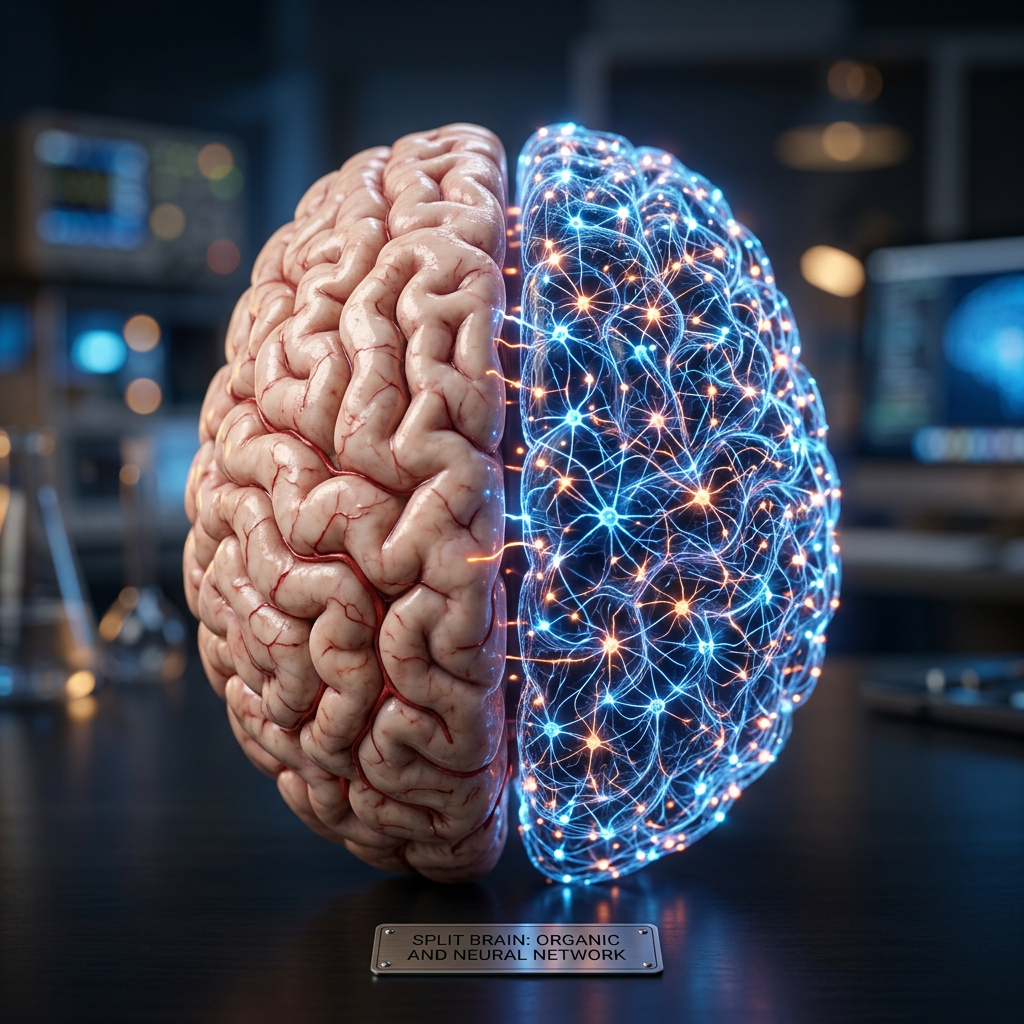
Technological development is formidable. When it comes to human development, however, there is cause for concern. This contrast is at the core of the analysis presented by researcher Imac Zambrana at the Future Sense Institute launch — and it deserves to be taken seriously.
This leads to two conversations about artificial intelligence. One focuses on what machines might do: which jobs will disappear, which breakthroughs are coming, and how fast progress is accelerating. The other conversation — rarely discussed — focuses on our own development as humans amid these changes. It was the latter that Imac Zambrana, a researcher in human development and cognition, addressed in her presentation at Future Sense Institute’s launch. Her analysis is uncomfortably clear: The problem is not machines improving too much, but our failure to maintain and develop the uniquely human skills only we possess.
Cognitive Simulation, Not Intelligence

The term “artificial intelligence” is rarely questioned. Zambrana suggests an alternative term: artificially simulated cognition. Today’s language models are the best simulation of human thinking yet—but a simulation is only an approximation, not the thing itself. Human intelligence consists of general capacities that we apply flexibly in many situations: pattern recognition, logic, reasoning, reflection, and the ability to apply what we learned yesterday to a problem we have never seen before.
The difference is not academic nitpicking. When tech leaders compare brain neurons with models’ parameters, they reveal above all how little they know about human capacity. Take language: The possible sentences a human can make are practically infinite. Most sentences we say have never been said before. And most words humans will use throughout history do not yet exist. The same applies to our sensory experiences, problem-solving, and reflection. Most of which we have not yet encountered. As Zambrana put it: Most of our cognitive capacity cannot be coded — and the tech industry could do with a little of that humility in their pitches.
This does not mean the development is overhyped. Advances such as multimodal models combining language, vision, and sensory data, hybrid systems that layer symbolic AI and “world models” atop statistical patterns, and remarkable progress in medical research were unthinkable just a few years ago. All of this is real, and it will change working life, education, and research.
But precisely because the technology is good, the question of what we do with ourselves becomes even more pressing, not less.
The Mathematics of Hype
An example from the talk illustrates why a sober perspective is needed. The analytics firm METR measures how long it takes AI models to complete long-running tasks. The latest models complete tasks that would take a human 16 hours, with about a 50 percent success rate. Impressive. But when such curves are extrapolated uncritically, one ends up with estimates that models will handle tasks equivalent to 580 times the age of the universe within a few years, as depicted in a humorous meme. Zambrana’s parallel example: An X user joking that his 3-month-old son has doubled his weight since birth and is on track to weigh trillions of kilos by age 10. Exponential curves are a rhetorical device as much as a forecast and are confused with time estimates when they are only meant to illustrate the shape of a curve.
And behind the hype are unpaid bills. Half of online content is now AI-generated and may pollute training data with noise. We face real data shortages in key areas that matter most— precisely because more and more human communication is produced with AI. The environmental costs of data center expansion hit resource-poor areas that are barely part of the conversation, and no one pays the full price of the technology. A choice that reflects a set of values. Around 150,000 tech jobs have been cut this year alone. And perhaps most seriously: a quiet loss of control over which problems we, as a society, choose to solve—a democratic challenge that rarely gets space in the debate.
The Output Argument
The main argument for handing control to machines is what Zambrana calls the output argument: As long as the result is better, what’s the problem? Projects that previously required large teams can now be carried out by one person. The convenience is obvious, and the results look great.
But “looks great” is precisely the problem. Psychologist Frank Keil’s classic experiments on knowledge illusions show that people believe they understand how familiar things like a zipper or a toilet work—until they are asked to explain it, and the illusion collapses. AI powerfully amplifies this by packaging superficial content in flawless form. A recent MIT and NYU study asked several language models to formulate pointed business strategies for specific companies. All the outputs included the same slogans and clichés, nothing tailored. A human expert would never have delivered that, but it looked convincing to those who don’t know.
The consequences are already visible. In higher education, students submit polished work that they cannot defend or explain orally. Developers report approving code with errors they typically would have recognized, because of the fast pace—and because their error-detection muscles weaken when not used. Norwegian examples exist too: the municipality that almost went through with school closures based on a report in which AI had fabricated the research references, and the publisher that had to withdraw a book because an AI prompt was left in the text. According to an Ipsos survey, 64 percent of Norwegians believe they have good control over artificial intelligence. The Dunning-Kruger effect— that those with the least competence overestimate their competence the most—has reached industrial scale.

A telling paradox: Top AI executives selling the AI future often send their own children to screen-free schools with the best human teachers and limit their children’s screen time to 15 minutes a day. They know something about what fosters human development.
The Amplifier
Does this mean AI makes us dumber? No, and the discussion following the talk highlighted the nuances. Several participants described AI as an amplifier of the starting point: The curious and hardworking use it smartly and improve, while the passive becomes passive with greater efficiency. Or as someone put it: If you buy an electric guitar with an amp but can’t play, it doesn’t get that much better.
There is also a recipe for smart use. An example that was highlighted: A student wrote the exam response themselves, fed the AI the school’s grading criteria, and asked it to act as an examiner. The first grade given by the AI was a D, with concrete points for improvement. The student improved the text themselves, round by round, until achieving an A. The learning happened through effort, not through outsourcing. The difference between using AI as a training partner and as a substitute, makes all the difference.
But the method requires something that is unevenly distributed: self-discipline and a willingness to endure cognitive discomfort—to sit with the resistance when you know the model could have “fixed it” in seconds. This raises a social question that several in the room pointed to: What about those who don’t train this muscle? Does school need technology-free hours where students look each other in the eyes and write by hand, simply to practice tolerating difficulty?
Three Questions to Live With
Zambrana’s antidote is three questions she challenges her students with, and that anyone who works with their mind should ask. The first: Can you explain what you think you understand? Not recite—explain fully, all the way. The exercise trains epistemic humility and awakens what she calls epistemic hunger. The second: What is your unique contribution? Deconstruct your work tasks and identify what you add that the machine cannot—because as they say a value not made explicit will not be considered. The third: How do you secure your contribution over time? The answer is twofold: Build technological competence, yes—but simultaneously build the human standard. Use AI for overviews but seek levels of deep understanding yourself and constantly expand it. Fewer people do this today, so it will set you a part. And don’t forget the transfer from human to human: Those aiming for mastery should seek out the experts and mentors who know it and learn how they think. Experience is an undervalued resource—as one participant who took a computer science course at Blindern in 1969 reminded us: Those who have seen many phases already know what ups and downs look like.
The Gap
Asked to look five years ahead, Zambrana was reluctant to make predictions—with good reason, predictions about technology have a dismal track record. But one trend she noted: The gap between the average and the outstanding will only increase. Not because the technology is bad, but because it rewards those who use it while maintaining their human potential—and lets the rest drift on an ever-smoother surface.
That is where the real competition lies. It is not AI that will take your job. It is a human who uses AI and their own brain to its full capacity. In the end, technology challenges us not just to consider what machines can become, but to focus on preserving and developing what only humans can do.
The article is based on Imac Zambrana’s presentation and the subsequent discussion at the launch of Future Sense Institute. The next gathering, on Agentic AI, will be held on August 2
Leave a Reply